
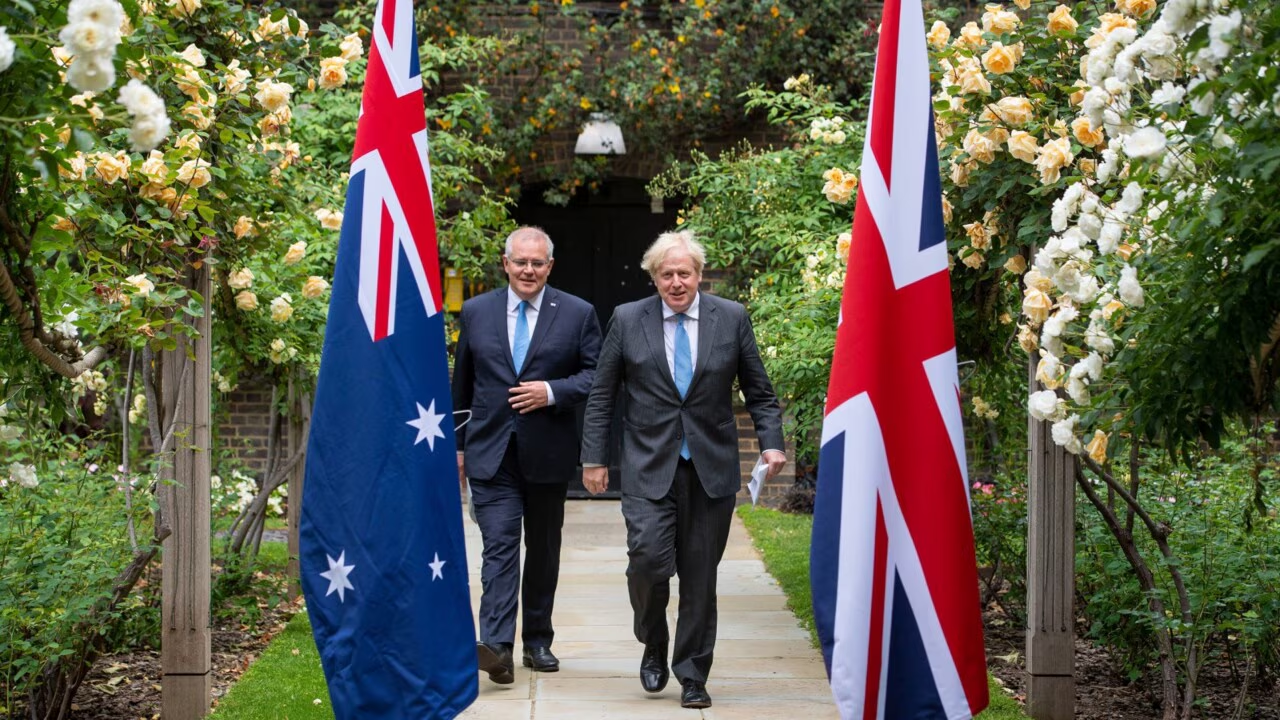
The Post-Brexit Trade Pivot
The UK-Australia Free Trade Agreement (FTA), signed in 2021 and implemented in 2023, stands as the most significant post-Brexit trade deal negotiated by the United Kingdom outside of its rollover agreements. Its importance is as much symbolic as it is economic, signalling the UK’s commitment to pivot towards the Indo-Pacific region and to embrace an unashamedly liberal, free-market approach to global trade. The core promise of the agreement was deep liberalisation, removing tariffs on almost all goods and setting modern standards for the digital economy.
However, this ambition has created a fundamental tension at the heart of the deal: while it opens significant doors for services, investment, and diversification, its uncompromising nature poses a critical test to the resilience and competitive capacity of specific domestic UK sectors. This agreement serves as a crucial barometer for the future direction of Britain’s trade policy and its capacity to manage the domestic consequences of global free trade.
II. The Opportunity: Trade Diversification and Digital Dominance
The primary benefits of the FTA are not found in the trade of physical goods, but rather in the sophisticated, high-value sectors that drive modern economic growth.
1. The Services and Digital Leap
The agreement features some of the most advanced provisions globally on digital trade, ensuring the free flow of data across borders while maintaining robust consumer protections. For the UK, which maintains a substantial global lead in services—including financial, legal, and technological consulting—this is the agreement’s main prize. It streamlines access for UK professionals to the Australian market and sets a favourable regulatory template for Britain’s pursuit of similar deep digital agreements, particularly as it looks to join the Comprehensive and Progressive Agreement for Trans-Pacific Partnership (CPTPP).
2. Investment and Supply Chain Resilience
Beyond digital trade, the FTA reinforces mechanisms for investment protection and facilitates easier cross-border capital flows. This strategic deepening of financial ties with a stable, advanced economy contributes directly to the UK’s goal of supply chain resilience. In an era defined by geopolitical risk, diversifying sources of investment and trade partners away from potentially volatile markets is a geopolitical necessity, strengthening the UK’s position as a reliable trading hub situated between Europe and the East.
III. The Competitive Strain: The Domestic Test
The greatest controversy surrounding the FTA stems from the ambitious, near-total removal of tariffs on goods, a move that has exposed key domestic industries to unprecedented competitive pressure.
1. The Agricultural Anxiety
The core of the domestic resistance lies in the agricultural sector. Australian farmers operate on a vast scale with different regulatory and cost structures compared to their UK counterparts. The deal guarantees Australian exporters zero-tariff access to the UK market for products like beef and lamb after a phase-in period. While the UK government asserts that strong safeguards, including volume quotas and a fifteen-year transition, mitigate the risk of market destabilisation, UK farming federations fear that they cannot compete with the potential influx of cheaper, mass-produced imports. This scenario forces UK agriculture into an immediate strategy of high-value, niche differentiation, rather than volume competition.
2. Labour Mobility and Skills Balance
The agreement also streamlines temporary labour mobility, making it easier for skilled workers and young professionals from both countries to move. While this addresses immediate skills shortages in sectors like construction and technology, it presents a complex balancing act. The UK must ensure that its long-term domestic investment in education and skills development keeps pace with demand, preventing a structural reliance on easy imports of skilled labour that could mask deeper problems in the UK’s own talent pipeline.
IV. A Template for Global Trade?
The UK-Australia FTA is intensely scrutinised by other potential trading partners because it serves as a strategic template. Its terms indicate the level of market access the UK is willing to concede for the sake of securing an agreement. Moving forward, the UK faces the challenge of reconciling its free-trade ideology—as exemplified by the Australian deal—with the pragmatic need to protect strategically important or politically sensitive domestic sectors. Future negotiations, particularly with markets that are less geographically and culturally aligned than Australia, will demand greater sectoral nuance and more robust protection clauses than those included in this foundational agreement.
V. Conclusion: The Test Ahead
The UK-Australia FTA is a testament to the UK’s ability to forge independent, modern trade agreements. It successfully positions Britain as a major services player in the Asia-Pacific region. However, it also acts as an exacting test of competitive resilience for the UK economy. The true measure of the FTA’s success will be less about the headline increase in bilateral trade volume and more about the degree to which UK businesses, particularly those in the newly exposed sectors, can adapt, innovate, and thrive under the pressures of global competition. The agreement is a bold statement—now the UK must prove that its domestic economy is robust enough to deliver on the promised opportunity.