
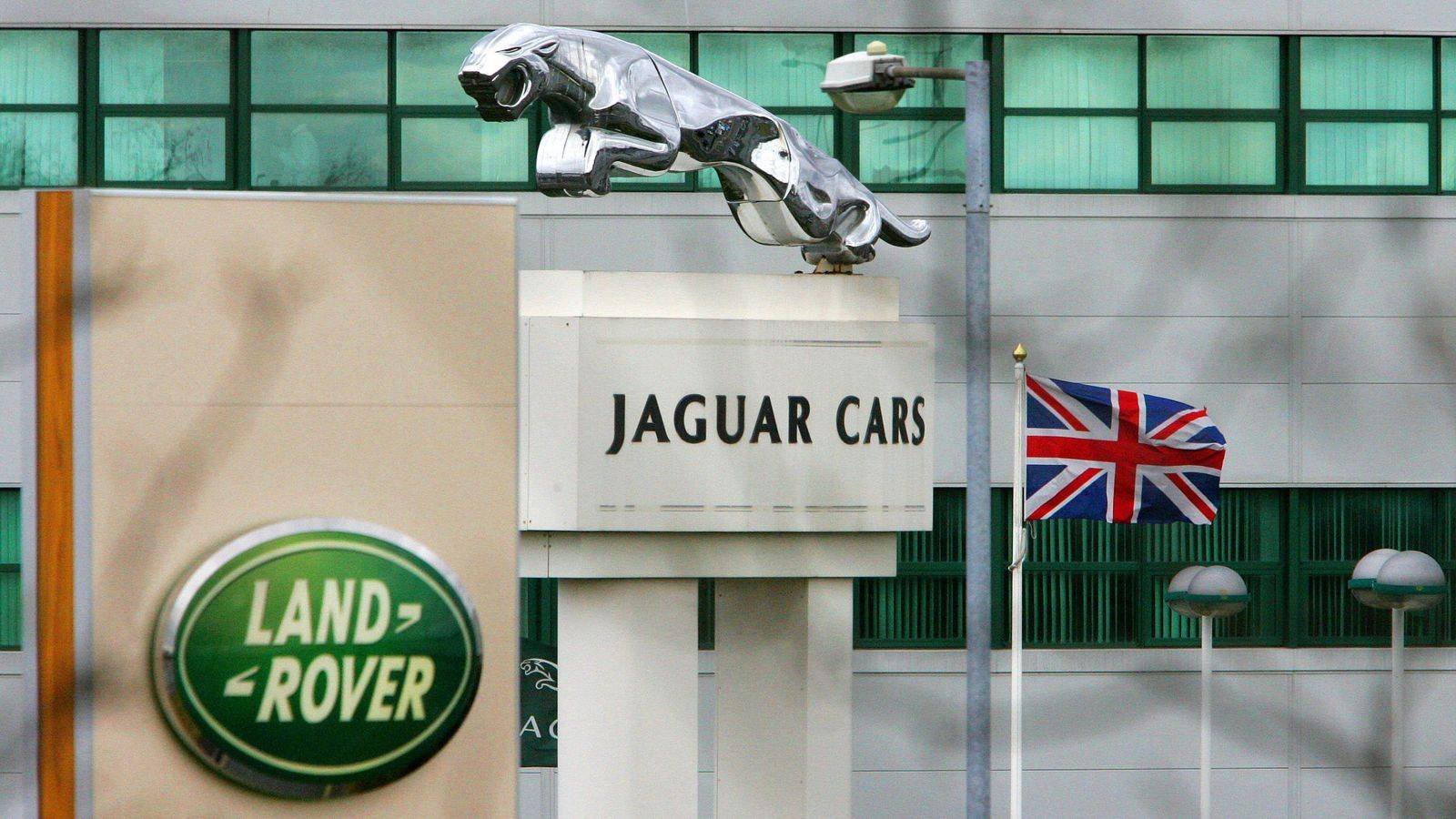
The UK’s economy decelerated in the third quarter of 2025. The economic expansion tapered to a rate near zero, at 0.1% of growth with many analysts attributing the slowdown to the cyberattack on Jaguar Land Rover (JLR) earlier in the quarter. The UK economy was already in a soft spot in terms of low productivity and slow investment, and this closure added to the burdens on Chancellor Rachel Reeves’s fiscal event.
UK economic growth weakens, with JLR halting production
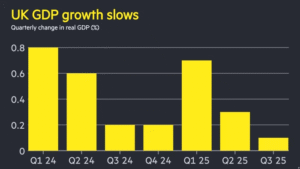
Recently released data by the Office for National Statistics illustrated an economy under stress. GDP increased by only 0.1% while GDP growth was slowing to 0.3% in the previous quarter. The month of September appeared to catch the downside, producing negative growth along with a contraction of 0.1%. Analysts indicated an expected flat activity reading and demonstrated something of a surprise when they showed contractions in the real economy ahead of the contract.
The original motivation for the shock in September was the cyberattack that halted JLR production. JLR was forced to cease output across its British factories, affecting several manufacturing sectors. In September, production of motor vehicles, trailers and semitrailers fell by 28.6%. Industrial activity declined sharply, worsening the country’s broader growth outlook. This slowdown pushed the UK deeper into an already fragile economic phase.
Lower manufacturing output also reduced the revenue expected to reach the Treasury. This created less fiscal space and increased uncertainty for government policy choices. The economic strain added pressure on the Chancellor’s upcoming fiscal plans. Businesses and analysts now expect clearer guidance on recovery measures. As the Chancellor prepares her strategy, the clock continues to tick.
A cyberattack on JLR exposes UK’s industrial vulnerabilities

Get JLR got hit at the end of August and brought its systems to their knees. JLR informed in a public statement on 2 September that the attack had damaged production and sales avenues. Engineers attempted to get the operation back on, but, by the time a complete operation was restored, it was late September. JLR regularly produces out roughly 1,000 new cars a day, so every lost day produced a latency effect.
More than 5,000 supplier felt the blast. Many of those suppliers rely almost exclusively on JLR contracts, and could not even produce output during the stoppage. Economists have estimated that the total damage was £1.9 billion, one of the most expensive cyber incidents recorded in the UK. The damage posed to both the automotive sector, and the national economy demonstrates how quickly a supply chain disruption can propagate far beyond an individual firm.
A more serious alarm for the UK industrial strategy
The attack also revealed more deep-seated structural issues. Many UK factories still use outdated digital technologies. Many companies invest too little in cyber protection because their margins remain low. These low margins make cybersecurity spending seem unattractive and inefficient. Criminals will still attack despite this lack of investment. They target major commercial players like Jaguar Land Rover. An attack on such a company threatens the entire production network.
The government now has the strategic challenge to overcome this issue. The country will need more confidence around digital safety, more agile recovery plans, and ease of coordination among manufacturers and suppliers. Without these measures in place, another cyberattack could lead to knock-on effects or findings of increasing shock. The UK economy is centrally dependent on industry segments that require secure data systems, and vulnerabilities can quickly escalate into something with national implications.
What is ahead for the UK economy?

Several economists are fearful that the slowdown may become more ingrained if industries do not recover sufficiently. Investors want a clearer view from Chancellor Reeves as she begins to formulate the public budget proposal. Business want to see incentives for digital security improvements, tax incentives for manufacturing incentives and pathways for supporting other important industries.
The cyber attack created an immediate emergency but the underlying challenge goes much deeper. The UK economy needs a stronger foundation, greater investment, and more secure digital infrastructure. And if the government can facilitate these areas/these projects then perhaps the UK may stumble upon a way to modernize its industrial base even amidst a disruptive phase.
The UK economy delivered a weak 0.1% growth in Q3 largely due to the collapse in the automotive sector demonstrating structural weaknesses in the national economy. But the aftermath of the recent Jaguar Land Rover cyberincident indicates how one event related to industrial production can have systemic impacts on the UK economy leading to reduced financial flexibility and recovery.