
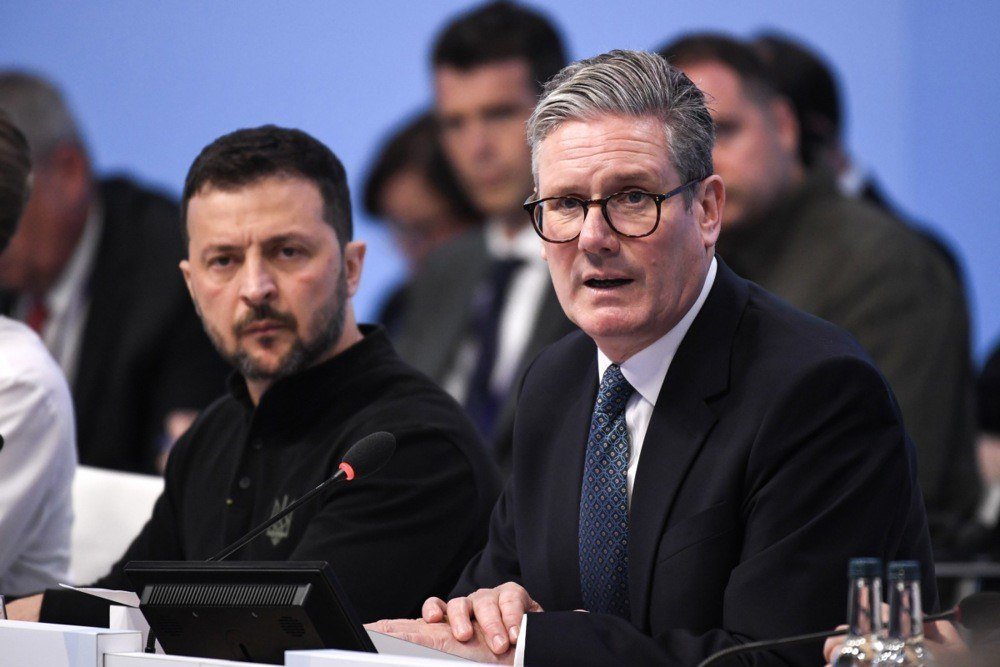
Ukraine is about to enter a significant diplomatic phase as a high-level meeting takes place at Downing Street between Volodymyr Zelenskyy, Keir Starmer, Emmanuel Macron and Friedrich Merz. The purpose of this gathering is to discuss the peace proposal put forward by the United States and assess whether the conditions are in place to consider a durable settlement. In a context where European balance, regional security and Ukrainian sovereignty are at stake, this meeting could mark one of the key geopolitical turning points of the year.
Zelenskyy and Starmer Meeting and the American Plan: Diplomatic Openings and Ukrainian Caution
The American peace plan submitted to Kyiv at the end of November has generated both hope and caution. Designed as a starting point for talks, it aims to revive dialogue after months of military stalemate. However, some of the initial provisions including territorial concessions or military limitations were immediately viewed as incompatible with Ukraine’s vital interests.
This prompted Kyiv to request substantial revisions to the text.
According to publicly disclosed information, several proposals considered overly favourable to Moscow were removed during subsequent discussions. The objective is now to reach a draft that does not undermine Ukrainian sovereignty. Yet Ukraine continues to express reservations, especially regarding the level of security guarantees that would accompany any potential agreement. Kyiv also questions Russia’s real ability to comply with a ceasefire and its true intentions.
The London meeting aims to clarify the structure of the plan, examine Kyiv’s proposed amendments, and determine whether European partners are aligned with the Ukrainian position. For Zelenskyy’s government, any agreement must safeguard the country’s territory, institutions and independence, both militarily and politically, to hold any genuine value.
The European Dimension: Strategic Unity and Security Guarantees Highlighted by the Zelenskyy and Starmer Meeting
The Downing Street summit takes place as European partners seek to project strategic unity. The war in Ukraine reaches far beyond its borders and reshapes the defence priorities of the entire continent. The United Kingdom, France and Germany alongside Zelenskyy want to show clearly their intention to stand at the core of a long-term European security framework.
Recent discussions between European nations have focused on the possibility of an international peacekeeping force. Raised during a virtual summit, this option would involve deploying troops on the ground to monitor a ceasefire and prevent any renewed hostilities. Yet the idea faces significant questions: which countries would commit troops? To what extent? And for how long?
For Europeans, such guarantees are a crucial part of the process. Without a credible military commitment from allies, any agreement could leave Ukraine dangerously exposed to violations. The London summit therefore becomes a key moment to define precise commitments and determine what responsibilities each nation is willing to take on.
Obstacles Ahead: Russia’s Position, Risks of Deadlock and Possible Scenarios
Despite multiple diplomatic efforts, major challenges remain. The Kremlin has already rejected parts of the revised plan, notably those concerning territorial issues. At the same time, drone and missile attacks continue to target Ukrainian infrastructure, underscoring that the war is far from over and that Moscow maintains pressure on the civilian population, particularly during the winter period.
Ukraine faces a difficult dilemma: accepting an imperfect agreement might calm the conflict, yet could undermine its sovereignty or introduce dangerous ambiguities regarding future security. Rejecting the plan would prolong the war, with heavy human and economic consequences. It is a decision with deep strategic implications.
Ultimately, the future depends on the partners’ ability to reach a unified position. Three main scenarios emerge: a robust peace agreement backed by international presence, a stalemate that prolongs the conflict, or a very minimal compromise resulting in an unstable peace. The London meeting will help determine which direction Europe and Ukraine will take.